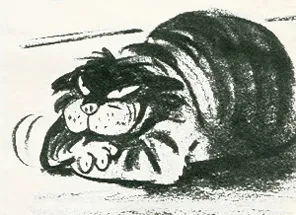
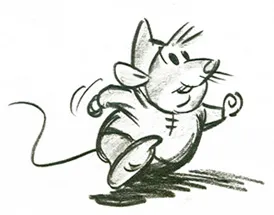
The film that rescued the Disney studio's postwar finances. Bill Peet was assigned the sequences he relished most: the villainous cat Lucifer, the comic mice Jaq and Gus, the Fairy Godmother, and the pumpkin transformation. He threaded comedy through the ancient fairy tale and gave the film the life it needed.
Bill reflected on his role in a 1978 interview with Mike Barrier: "I was given the cat and mouse stuff, a lot of that. I got the juicy parts. The fairy godmother, and the cat and the mice, that's the meat of the picture. Meeting the prince at the ball, thank God I didn't get that one! Without comedy, the film would have been as dead as Sleeping Beauty. You can't tell a well-worn old folk tale without putting a lot of gingerbread in there. In Disney films, little stuff is what makes them."
His contribution
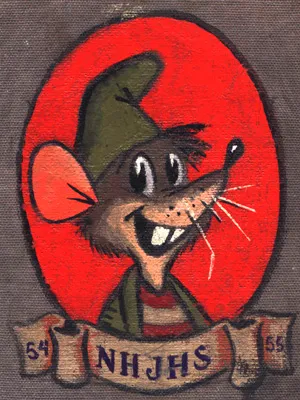
Bill created the extended cat-and-mouse sequences that give Cinderella its energy, engineering the comic interplay between the scheming Lucifer and the resourceful mice Jaq and Gus. He also designed and boarded the Fairy Godmother transformation sequence. He painted a portrait of Jaq the mouse on the cover of his son Bill Jr.'s three-ring school notebook, a small token of how fully he inhabited these characters. "It was a matter of engineering the whole thing, and threading the comedy through it. I don't think that plot-wise there was any problem from the beginning." (Bill Peet, interview with Mike Barrier, 1978)
Story sketches
- RELEASED
- March 4, 1950
- DIRECTOR
- Clyde Geronimi, Hamilton Luske, Wilfred Jackson
- BASED ON
- Cendrillon by Charles Perrault (1697)
- BILL'S ROLE
- Story (cat and mouse sequences, Fairy Godmother, comic relief)
- RUNTIME
- 74 min